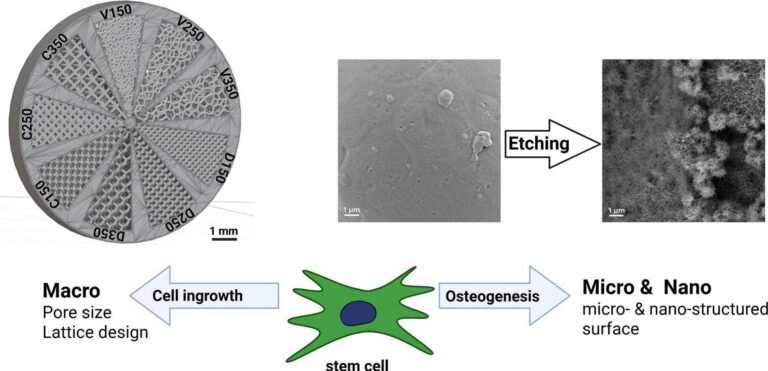
Additive manufacturing via Laser Powder Bed Fusion (LPBF) has revolutionized orthopedic implant design by enabling custom macro-porous architectures that facilitate tissue integration and biofluid movement. However, the synergistic interplay between macro-scale pore geometry and micro/nano-scale surface topographies on osteogenesis has remained largely unmapped.
A landmark study published in Materials & Design by Lu Yuan et al. presents a comprehensive multi-scale framework for optimizing porous titanium scaffolds.
Key Research Findings
- Macro-Scale Geometry Controls Cell Ingrowth: Evaluating titanium alloy discs across nine distinct pore configurations revealed that macro-pore geometry primarily dictates cell density and the physical depth to which human mesenchymal stem cells (hMSCs) penetrate the scaffold.
- Micro- and Nanostructures Drive Differentiation: Applying an acid-alkaline heat treatment created micro- and nanoscale surface features that significantly enhanced osteogenic differentiation.
- Mechanotransduction Activation: The micro- and nano-engineered surface stimulates mechanotransduction ion channels (such as Piezo1), promoting greater extracellular matrix production—specifically collagen type I synthesis and calcium deposition.
- The Optimal Design: Among the tested configurations, a Diamond lattice structure featuring larger pore dimensions combined with a micro/nano-textured surface delivered superior osteogenic performance and mineralized matrix deposition.